
Online Reselling vs Offline Thrift: The Indian Reality
Mon Jan 19 2026 · 3 min read
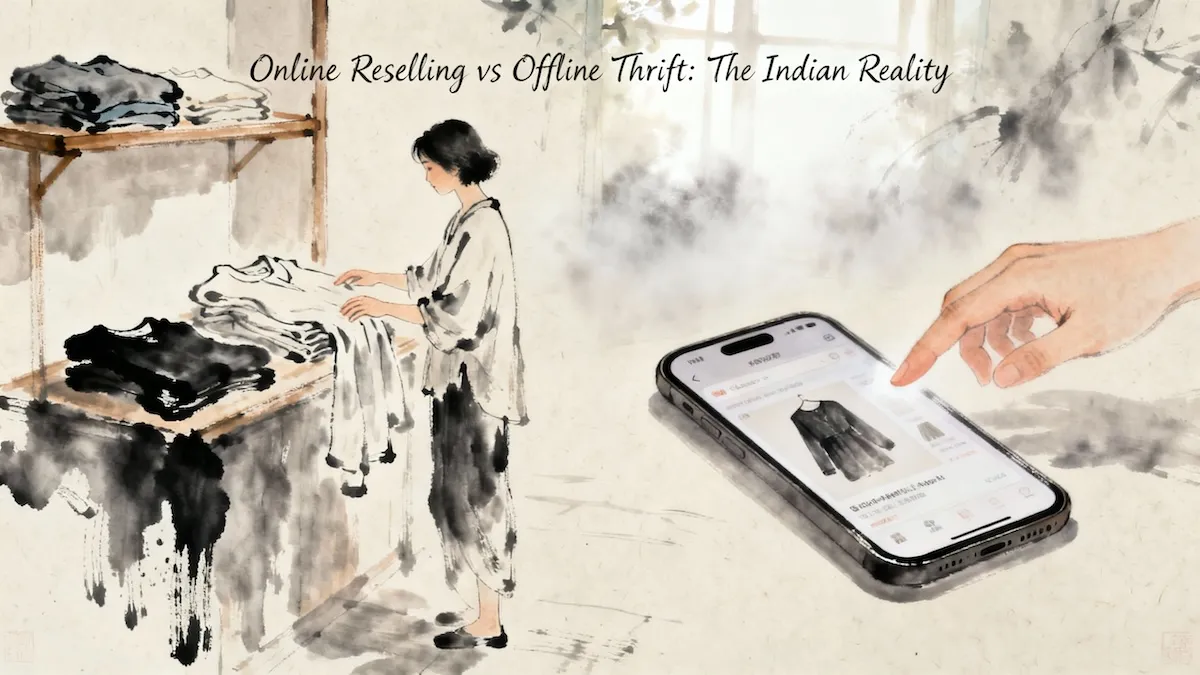
In India, online reselling looks easier than offline thrift.
Lower rent.
No physical store.
Everything happens on the phone.
This perception attracts thousands of newcomers every year.
But ease and sustainability are not the same thing.
When you compare both models from ground reality, the difference becomes clear very quickly.
Model #1: Online Reselling
How it usually starts
Most online resellers begin with small quantities.
They source mixed stock.
Pick individual pieces.
Upload photos.
Wait for DMs.
At first, it feels flexible and fast.
Where the cracks appear
Online reselling in India is labor-heavy.
Every sale requires:
- individual selection
- photography
- negotiation
- packing
- shipping
- post-sale coordination
Margins look high per piece, but time cost is ignored.
Returns, cancellations, and payment delays are common.
Over time, effort increases faster than income.
The hidden ceiling
Online reselling does not scale cleanly.
As volume increases:
- errors increase
- burnout increases
- control decreases
What starts as freedom slowly becomes dependency on constant attention.
The system depends on the operator being “online” all the time.
Model #2: Offline Thrift
How it actually works
Offline thrift is not glamorous.
It is repetitive.
Predictable.
Routine-driven.
Stock comes in bulk.
Prices are visible.
Sales happen face-to-face.
The system runs even when the operator is not actively selling each piece.
Why it suits Indian markets
In most Indian cities:
- buyers prefer touch-and-feel
- price clarity reduces friction
- footfall matters more than reach
Local buyers do not want long conversations.
They want simple choices and clear prices.
Offline stores satisfy this behaviour naturally.
The discipline requirement
Offline thrift only works with rules.
No random sourcing.
No emotional pricing.
No long holding of stock.
When discipline breaks, losses are slow but certain.
Key Difference #1: Time vs Structure
Online reselling trades time for margin.
Offline thrift trades structure for stability.
One depends on constant personal effort.
The other depends on systems working repeatedly.
In the long run, structure outlives energy.
Key Difference #2: Cash Flow Behaviour
Online reselling
Cash comes in unevenly.
Returns reverse revenue.
Inventory sits digitally, not physically rotating.
Planning becomes difficult.
Offline thrift
Cash flow is daily and visible.
Stock rotation is observable.
Slow categories are identified early.
Rent and salaries are predictable.
So the business can be planned.
Key Difference #3: Margin Reality
Online margins look higher on paper.
But after:
- time cost
- logistics
- cancellations
- unsold picked stock
real margins shrink.
Offline thrift margins are lower per unit, but cleaner.
Volume and rotation compensate for lower ticket sizes.
Why Offline Wins in Tier-2 and Tier-3 Cities
In cities like Meerut, Indore, or Gwalior:
- offline footfall is strong
- digital trust is limited
- bargaining culture is real
Offline-first operators often outperform online resellers here.
Not because they are smarter,
but because the model fits the behaviour.
Where Centralized Supply Changes the Game
Both models fail without supply discipline.
But offline thrift benefits more from:
- predictable bulk sourcing
- consistent quality bands
- fixed pricing logic
Centralized thinking removes randomness.
It reduces dependency on individual judgment and mood-based decisions.
This is why system-led offline models survive longer than personality-led online reselling.
Final Thought
Online reselling feels lighter.
Offline thrift feels heavier.
But weight creates stability.
In India, businesses that survive are not the most flexible ones.
They are the most disciplined ones.
Choose the model that matches how long you want to stay in the game.
Interested in building a disciplined offline thrift business?
Apply as City Partner